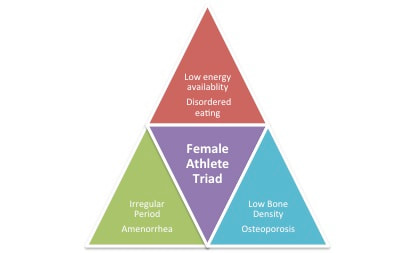
 The Female Athlete Triad is a condition that includes three components:
– Low bone density (risk for stress fractures and osteoporosis) – Disordered eating – Amenorrhea (no menstrual cycle for three months or more) (Matzkin et al., 2015). The consequences of the Female Athlete Triad can be long-term and irreversible, and include stunting of growth, reproductive dysfunction, and osteoporosis. Any female athlete is at risk for this syndrome, but women who participate in dance are more susceptible because of the desired lean aesthetic and rigorous training schedule (Barrack et al., 2014). Peak bone density is achieved between ages 18 to 25 years. Poor nutrition (i.e., insufficient calories, calcium and vitamin D), stress, and intense training lead to hormonal disruption during the peak-forming period. Reduced estrogen production leads to bone resorption, and this can occur despite the fact that load-bearing physical activity such as dance usually improves bone-mineral density. Some female athletes have bone density similar to older postmenopausal women, which is dangerously low. One study reported that 80% of female dancers diagnosed with stress fractures of the second metatarsal started their menstrual period late (O’Malley, 1996). This type of bony injury requires at least 6-8 weeks to heal and even longer to rehab. The remedy for Female Athlete Triad requires that energy needs be met consistently, either by modifying diet or reducing exercise. If body fat is inadequate, restoring body weight to a healthy level is the best strategy for normalizing menstrual periods and improving bone health. References:
1 Comment
3/1/2019 13 Comments Stress Fractures in Dancers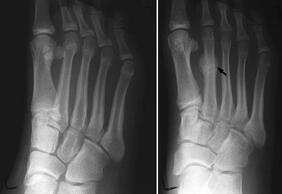 Stress fractures occur in up to 46% of dancers during their career (Delegete, A). Over 60% of these fractures occur during puberty. Decreased strength, proprioception, and balance control, as well as poor technique can lead to increased stress to the bones and thus increased risk for stress fracture. Females are twice as likely than males to have a stress fracture secondary to caloric restriction, reduced bone mineral density, and menstrual irregularities (Delegete, A).
RISK FACTORS
POSSIBLE SIGNS/SYMPTOMS:
REDUCING RISK Rehabbing a stress fracture can involve complete rest for 6 to 10 weeks. It is important to recognize possible signs and risk factors to avoid bone damage.
References: 1) Delegete, A. Health Considerations for the Adolescent Dancer. A webinar through the Harkness Center for Dance Injuries. Accessed September 23, 2018. 2)Weiss, David S. Stress Fractures in Dancers: Evaluation and Treatment. A webinar through the Harkness Center for Dance Injuries. Accessed November 11, 2018. Strength, precision, and artistry set you apart at an audition. Optimal nourishment and rest is important. Audition at your best by staying in peak shape with these helpful tips.
Before audition day:
Skills to focus on during your audition:
References: Koutedakis, Y. (2000). " Burnout” in Dance: the physiological viewpoint. Koutedakis, Y., & Jamurtas, A. (2004). The dancer as a performing athlete. Sports Medicine, 34(10), 651-661. The adolescent dancer faces unique challenges due to physical and emotional changes that occur during pubertal development. Rapid growth periods can lead to reduced strength, impaired balance, and decreased flexibility, which can alter technical ability and increase the risk of injury.
GROWTH CHANGES Growth spurts in dancers usually occur between the ages 11-15 in girls and 13-17 in boys, and can last up to two years (IADMS 2000). As height increases, weight gain also occurs. A girl’s menstrual cycle begins during these growth phases and is essential for formation of bone. The pressure to stay thin during periods of weight gain in addition to being unaware of/ignoring nutritional needs results in an energy deficit and increases the likelihood of irregular periods (Delegate 2018). Bones grow at a faster rate than muscles and tendons, and limbs grow at a faster rate than the trunk. This affects strength, flexibility, and balance control in dancers. These changes can make movement feel awkward and may affect your ability to perform at the level that you are used to. Don’t be discouraged, these changes are temporary! INJURY RISKS The injury rate increases by 35% as dancers reach ages 14-16. Body regions most commonly affected are the foot/ankle, lumbar spine, hips, and knees (Steinberg 2012, Delegate 2018). Common injury types in adolescents:
REDUCING INJURY RISK DURING GROWTH CHANGES:
References: 1)Education Committee (Kathryn Daniels, Chair). International Association for Dance Medicine & Science. November 2000 https://www.iadms.org/page/1 2) Delegete, A. Health Considerations for the Adolescent Dancer. A webinar through the Harkness Center for Dance Injuries. Accessed September 23, 2018. 3) Steinberg, N., Siev-Ner, I., Peleg, S., Dar, G., Masharawi, Y., Zeev, A., & Hershkovitz, I. (2012). Extrinsic and intrinsic risk factors associated with injuries in young dancers aged 8–16 years. Journal of sports sciences, 30(5), 485-495. 4) Steinberg, N., Siev-Ner, I., Peleg, S., Dar, G., Masharawi, Y., Zeev, A., & Hershkovitz, I. (2013). Injuries in female dancers aged 8 to 16 years. Journal of athletic training, 48(1), 118-123. 9/10/2018 1 Comment Am I ready for pointe work?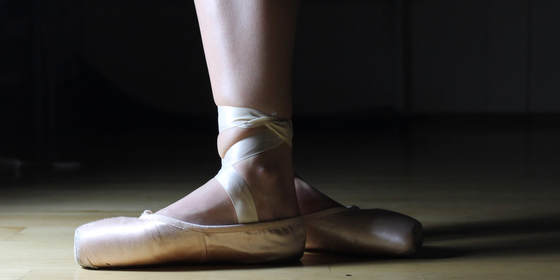 A dancer’s progression to pointe work is a much anticipated moment. It is completely normal to be excited about this milestone, but it is extremely important not to rush into pointe work. There are a variety of factors that need to be considered to ensure that a dancer is ready to sufficiently meet the demands of pointe work.
Criteria for pointe readiness based on expert recommendation:
What are the risks if I start too early? If the dancer begins pointe work without adequate range of motion and/or neuromuscular control, they can hinder proper technique development, foster bad habits, and potentially increase the amount of stress on the developing bones as well as the surrounding musculature. There is rapid bone growth and remodeling between the ages of 9-15 years old. During this time, growth plates are weaker than the surrounding bone, making them less resistant to different forces and more susceptible to injury. In addition, there are neuromuscular changes that occur as the dancer accommodates to rapid growth. The dancer takes time to adapt to changes in strength, flexibility, and proprioception, which ultimately influences motor control and performance en pointe. Therefore, chronological age cannot be a sole marker for pointe readiness (Richardson 2017, Shah 2009). It is important to communicate with your ballet teacher regarding the progress of your technique and whether you meet the criteria to initiate pointe work. Health care professionals (MD, PTs) with a background in dance can assist in conducting pointe readiness screens. *Description of pointe readiness tests:
1) Richardson, M. Principles of Dance Medicine, Functional Tests to Assess Pointe Readiness. A webinar through the Harkness Center for Dance Injuries. Accessed Feb 23, 2017. 2)Bullock-Saxton, J. E., Janda, V., & Bullock, M. I. (1994). The influence of ankle sprain injury on muscle activation during hip extension. International journal of sports medicine, 15(06), 330-334. 3) Richardson, M., Liederbach, M., & Sandow, E. (2010). Functional criteria for assessing pointe-readiness. Journal of Dance Medicine & Science, 14(3), 82-88. 4) Shah, S. (2009). Determining a young dancer's readiness for dancing on pointe. Current sports medicine reports, 8(6), 295-299.  Summer intensives typically involve long training days. A dancer may train 6-7 hours a day for 5-6 days a week. It is important that a dancer is physically prepared to sustain these long hours to avoid overuse injuries and burnout. Preparing for Long Training Days:
Come Back Stronger Avoid working through through fatigue, illness, or injury. Always seek help from a medical practitioner if an injury occurs. Ensure that you are getting adequate rest in between training days to prevent tissue damage. The muscle requires 12-24 hours of rest following intense levels of physical activity in order to heal and repair damaged tissue prior to additional workouts (Koutedakis 2000). Set a mandatory rest period after summer intensives and avoid jumping into another intensive. It is recommended that a dancer takes a rest period of 2-5 weeks after an intensive or performance season to improve/maintain strength, flexibility, and aerobic capacity. Cross-training can be performed during rest periods (Koutedakis 2004). A rest period is critical for adequate recovery and time to reflect what you have learned. 1) Koutedakis, Y., & Jamurtas, A. (2004). The dancer as a performing athlete. Sports Medicine, 34(10), 651-661. 2)Bullock-Saxton, J. E., Janda, V., & Bullock, M. I. (1994). The influence of ankle sprain injury on muscle activation during hip extension. International journal of sports medicine, 15(06), 330-334. 3)Koutedakis, Y. (2000). " Burnout” in Dance: the physiological viewpoint.   Rest is essential for recovery and healing. It is a recommended to take a couple weeks off after a summer intensive. Adjustments in food intake should be made during these rest periods. Typically, one week is not enough time for your metabolic rate to decrease or for lean mass to dissipate significantly. However, durations longer than one week can result in loss of muscle mass and fat gain if you're not supplementing with resistance training and/or adjusting calorie intake. Plan to make small, simple changes to account for the reduced calorie expenditure when you're not dancing. Be careful not to overcompensate with extreme calorie restriction.This is counterproductive and can cause muscle loss, illness, and injury when you begin training again.
What adjustments should be made to diet during the off-season?
Rather than restricting calories during vacation or off-season, consider cross-training with cardio and resistance training. Low-impact, moderate-intensity cardio such as swimming or fast walking are excellent options to allow for extra calorie burning and promote muscle retention. Walking at ~3.8 to 4 miles per hour (3 to 4 miles/day) or swimming for 30 minutes at a moderate intensity are good options. Add light resistance training with weights, Pilates, or yoga while on a break from dance in order to maintain flexibility and promote muscle gain. Enjoy your summer and remember that you deserve a break! 5/9/2018 0 Comments Dancing Through Burnout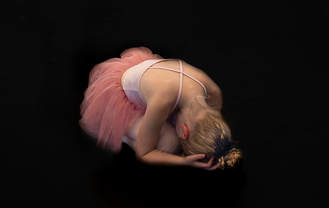 Burnout or overtraining can be characterized by:
Risks for burnout and injury:
Signs/symptoms of burnout:
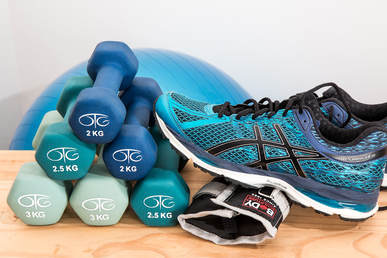 Solutions and setting realistic expectations:
1) Allow for full rest days in between heavy training days. This will provide adequate time for tissue healing and recovery and prevent further tissue damage. 2) Set mandatory rest periods after performance seasons and summer intensives. It is recommended that a dancer takes a rest period of 3-5 weeks off from dance. Research shows that rest periods improve/maintain strength, flexibility, and aerobic capacity. Cross training can be performed during rest periods (Koutedakis 2004). 3) Get adequate sleep. Dancers may need up to 9 to 10 hours of sleep per night during intense training periods. Set an early bedtime for yourself and try to avoid screen time distractions before bed. 4) Eat a balanced diet. It is important to have adequate nutrition to boost your immune system and optimize your performance. 5) Don’t work through fatigue, illness, or injury. 6) When returning to dance, slowly ramp up activity load. Consider starting with a modified dance schedule when returning from rest periods. 7) Increase endurance. Most injuries occur when a dancer is fatigued and therefore it is important to improve aerobic capacity to delay fatigue. About 20 minutes of moderate to vigorous cardiovascular exercise such as swimming or cycling can bring about aerobic fitness increases. Swimming is a preferable choice for improving endurance over activities such as running or cycling, which place much more demand on the lower extremities (Koutedakis 2004). 8) Increase muscle strength. Body conditioning, weight lifting, and pilates are excellent for increasing lean muscle mass. 9) Address the signs of burnout early to avoid prolonged symptoms. 10) Consider reducing your schedule intensity if you are dancing > 5 hours a day or > 20 hours per week. REFERENCES: 1) Koutedakis, Y. (2000). " Burnout” in Dance: the physiological viewpoint. 2) Koutedakis, Y., & Jamurtas, A. (2004). The dancer as a performing athlete. Sports Medicine, 34(10), 651-661.  Dance is highly demanding and requires exceptional flexibility, balance, power, agility, coordination, and endurance. To properly execute movements, a dancer assumes positions that place excess stress on bones, muscles, tendons, and ligaments, thus leading to high injury rates. The injury incidence is reported to be as high as 5.6 per 1,000 dancing hours for pre-professional dancers, and 4.44 per 1,000 hours in a company of professional dancers (Allen et al, 2012). In comparison, the injury rate for elite gymnasts is 2.86 per 1,000 hours and 0.69 for novice gymnasts (Saluan et al, 2015). Gymnasts have a higher percentage of traumatic injuries, whereas 75% of the injuries sustained in dance are related to overuse. Overuse injuries are caused by repetitive movements/stress which can lead to micro-injury of the tissue that is being loaded. If the injury rate exceeds the rate of healing/repair, the tissue can become damaged (Sephton, 1998). The majority of dancers are fatigued at the time an injury occurs. This is because fatigue compromises muscle performance, coordination, joint stability, and neural feedback (Liederbach 2012). Overuse injuries tend to be more severe in nature and result in more dance time lost. Lower leg injuries are reported to be between 66 and 78% of the injuries, whereas foot/ankle injury comprises 14 to 57% of all injuries among dancers. Injuries sustained during class and performances are more severe than injuries that occur during rehearsals (Allen 2012). Common risk factors for injury include:
References: 1.Allen, N. Nevill, A. Ballet Injuries: Injury Incidence and Severity over 1 Year. Journal of Orthopaedic and Sports Physical Therapy. Vol 42, number 9, September 2012. 781-790. 2.Saluan, Paul et al. “Injury Types and Incidence Rates in Precollegiate Female Gymnasts: A 21-Year Experience at a Single Training Facility.” Orthopaedic Journal of Sports Medicine 3.4 (2015): 2325967115577596. PMC. Web. 4 Feb. 2018. 3.Sephton, Sharlene. "Foot Injuries in Dancers." ADVANCE for Physical Therapy and Rehab Medicine (1998) Web. 4 Feb. 2018. 4.Liederbach, Marijeanne. "Epidemiology of Injuries in Dance: Biopsychosocial Considerations." Principles of Dance Medicine: Clinical Management of the Dancer Patient. July 12, 2012, New York University Langone Medical Center. 2012. Print. 5. Russell, J. A. (2013). Preventing dance injuries: current perspectives. Open access journal of sports medicine, 4, 199. 6. Allen, N., Ribbans, W. J., Nevill, A. M., & Wyon, M. A. (2014). Musculoskeletal injuries in dance: a systematic review. Int J Phys Med Rehabil, 3(252), 2  1/23/2018 0 Comments Welcome to Health en Pointe!Our goal is to empower the dance community by providing helpful tips and resources to optimize health, improve function, and ultimately extend one’s career. Pursuing a successful dance profession should not inflict chronic pain, perpetual stress, or diet confusion. The competition and politics of the dance world can be discouraging, but with realistic and intelligent strategies to address your challenges, you can thrive as a dancer! Health en Pointe provides evidence-based information on injury prevention, nutrition, and wellness for current and former dancers.
We are a qualified team of health professionals that understand the life of a dancer. Here is some information about the founders of Health en Pointe, Moira the Physical Therapist, and Nasira, the Registered Dietitian: Moira is a former competitive gymnast and dancer. She trained at various summer intensives such as Kaatsbaan Ballet and Houston Ballet. She graduated Summa Cum Laude from the University of Arizona with a B.F.A in dance. She danced and performed pieces in jazz, modern, and ballet. In 2015, Moira graduated from California State University Long Beach with a Doctorate in Physical Therapy. She has also completed training in vestibular rehabilitation from the prestigious Rehabilitation Institute of Chicago. Currently, she is working at Progressive Physical Therapy in Costa Mesa. She is also serving as the PT resource for the ABT Gillespe School in Orange County. Her extensive dance background in various movement styles engendered a unique understanding of complex movement patterns and translated into a knowledgeable approach to treating movement dysfunction. In addition, her first-hand experience with dance affords her unique understanding on preventing and treating the various disorders associated with dancers of all ages. In her free time, she teaches Pilates and lectures on prevention and management of dance related injuries. She is working on completing her Pilates apparatus accreditation with Body Arts And Science International (BASI) and is actively incorporating her learned skills in daily treatment sessions. Nasira is a registered dietitian, fitness expert, and professor of nutrition. She was drawn to public health and nutrition as a result of her diverse background in science, fine arts, and fitness. Nasira is currently an adjunct faculty member at Chapman University, a private practice registered dietitian, and post-doctoral researcher. She also guest-teaches ballet throughout Orange County. She has been a classical ballet dancer for over 18 years and trained with Pacific Northwest Ballet in Seattle, WA and the University of Arizona School of Dance and attended summer intensives at the National Ballet of Canada and American Ballet Theater NY. The BFA program at the U of A prepared her for a career as a professional dancer, choreographer, and dance instructor, however, her passion for science led her to pursue an alternative path. Upon graduating Summa Cumma Laude from the University of Arizona, Nasira continued her studies in pursuit of a career as a nutrition professional and obtained a Masters in Public Health from UCLA and a Doctorate in Nutritional Sciences from Loma Linda University. Nasira has been a certified personal trainer since 2008, and is a certified yoga instructor. Her experience in the fitness industry has deepened her knowledge of biomechanics and kinesiology, which has improved her dance technique and understanding of injury prevention. We hope you find Health en Pointe to be an integral resource and become a better dancer because of it. We encourage your active participation in this blog and welcome comments, questions, and sharing. Please visit us often! |
CategoriesAll Cross Training Injury Prevention Nutrition Recipes Wellness Archives
October 2021
|
 RSS Feed
Proudly powered by Weebly