 Dancers consume fewer calories than they expend (Dahlstrom et al., 1990; Beck et al., 2015; Hassapiduo et al., 2001; Doyle-Lucas et al., 2010; Brown et al., 2017) due to busy schedules, deliberate calorie restriction, pressure to maintain low body weight, and a lack of knowledge. Taking class on an empty stomach increases muscle breakdown, which is undesirable for dancers who need strength to dance. It is critical that dancers consume carbohydrates prior to training to reduce muscle fatigue and help preserve muscle fibers that generate power for jumping. The purpose of a pre-exercise meal - consumed within an hour or less before training - is to hydrate, top off glycogen stores, and decrease hunger. If you take a class early in the morning, you have most likely fasted overnight and will need carbohydrates to help fuel your first class. Consuming carbohydrate spares the use of protein for energy, thereby freeing up protein to synthesize muscle and repair tissue. Poor nutrition may result in the following consequences:
Recommendations Dancers should consume about 15 calories per pound body weight, plus the training energy expenditure, which is approximately 200 calories per hour of class or rehearsal. For example, a 130-pound (60-kg) dancer might need 1,860 calories per day plus an additional 500 to 800 calories to meet the demands of class, rehearsal or performance that day, for a total of 2,360 to 2,660 calories. Nutrition needs are very individualized, so it is important that dancers seek dietary advice from qualified specialists (i.e., a Registered Dietitian for dancers). References: Brown, M. A., Howatson, G., Quin, E., Redding, E., & Stevenson, E. J. (2017). Energy intake and energy expenditure of pre-professional female contemporary dancers. PLoS ONE, 12(2), e0171998. Dahlstrom M, Jansson E, Nordevang E, Kaijser L. (1990). Discrepancy between estimated energy intake and requirement in female dancers. Clinical physiology; 10(1):11-25. Epub 1990/01/01. Hassapidou MN, Manstrantoni A. (2001). Dietary intakes of elite female athletes in Greece. Journal of human nutrition and dietetics: the official journal of the British Dietetic Association;14(5):391-6. Epub 2002/03/22. Kostrzewa-Tarnowska A, Jeszka J. (2003). Energy balance and body composition factors in adolescent ballet school students. Polish Journal of Food and Nutrition Sciences;12(3):71-5. Beck KL, Mitchell S, Foskett A, Conlon CA, von Hurst PR. (2015). Dietary Intake, Anthropometric Characteristics, and Iron and Vitamin D Status of Female Adolescent Ballet Dancers Living in New Zealand. Int J Sport Nutr Exerc Metab; ;25(4):335-43. Epub 2014/11/12. doi: 10.1123/ijsnem.2014-0089 25386731 Doyle-Lucas AF, Akers JD, Davy BM. (2010). Energetic efficiency, menstrual irregularity, and bone mineral density in elite professional female ballet dancers. J Dance Med Sci;;14(4):146-54. Epub 2010/01/01. 21703085 Hirsch NM, Eisenmann JC, Moore SJ, Winnail SD, Stalder MA. (2003). Energy Balance and Physical Activity Patterns in University Ballet Dancers. Journal of Dance Medicine & Science;7(3):73-9. Sousa, M., Carvalho, P., Moreira, P., Teixeira, V. (2013). Nutrition and Nutritional Issues for Dancers. Medical Problems of Performing Artists, 28, 119. Montanari, A., & Zietkiewicz, E. A. (2000). Adolescent South African ballet dancers. South African journal of psychology, 30(2), 31-35.
1 Comment
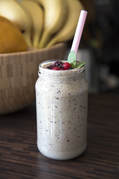 Do you need some unique ideas for a breakfast smoothie or a portable meal? Check out these recipes from Nasira. The instructions are simple for each: add all ingredients to a blender, puree until smooth, and enjoy! Consider using an insulated thermos to keep your smoothie cold until lunch or snack time.
Oat Avocado Smoothie ½ cup plain non-fat Greek yogurt 1/2 cup unsweetened almond milk ¼ cup raw rolled oats 1 frozen ripe banana ¼ cup mashed avocado ½ ripe pear 1 Tbsp ground flaxseed 1 scoop soy or whey protein powder Cocoa Almond Smoothie 1 very ripe frozen banana 3 Tbsp almond butter ¾ cup white Northern beans (drained) 1 Tbsp chia seeds or flaxseeds 2 Tbsp unsweetened cocoa powder 1 cup unsweetened almond milk Green Vanilla Mint Smoothie ½ avocado ¼ cup unsweetened almond milk ¼ cup fresh baby spinach Fresh mint leaves or ½ tsp mint extract ¼ cup vanilla or plain whey protein or egg white protein powder 2 Tbsp unsalted pistachio nuts 1 Tbsp Stevia 1 tsp vanilla extract Strawberry Banana Smoothie 1 cup unsweetened almond milk 1 cup strawberries, quartered 1 banana, frozen 1/2 cup plain greek yogurt 1 Tbsp ground flaxseed meal 2 scoops soy or whey vanilla protein powder Tropical Chia Fruit Smoothie 1 cup unsweetened almond milk ¼ cup unsweetened shredded coconut ½ cup mango chunks, fresh or frozen ½ cup pineapple chunks, fresh or frozen 2 scoops soy or whey protein powder  Good nutrition is essential to help dancers achieve ideal body composition and ensure adequate energy to support growth and fuel training. Training may last for the majority of the day and run over several meal times, so it's important to take a variety of snacks and small meals along to the studio or rehearsal venue. If there are small breaks between classes, light snacks like cereal bars, smoothies, fruit, and low-fat yogurt are ideal. If there are larger breaks during the day, sandwiches, wraps, frittatas, rice, couscous, potato, or pasta salad might be more suitable. Protein should be included in each snack to repair and maintain muscle. Protein synthesis (i.e., muscle building) occurs by consuming as little as 15 to 25 grams of complete protein (e.g., egg, dairy or soy) after exercise. There are numerous foods that offer quality, complete protein - you can learn more about them in our upcoming post about protein quality! Including healthy fats, such as the kind found in nuts and seeds, in your snacks will promote concentration and enable quick thinking during rehearsals.
Here is an example of a one-day meal plan for a day consisting of two dance classes (1.5 hours each) and an evening rehearsal (1.5 hours):
This is a basic example. Food options are customizable according to your schedule, food preferences, and tolerances. An individual meal plan requires preparation, so don’t hesitate to bulk prep on the weekends to allow for easy meal packing during your busy week of class and rehearsal. Check back soon for more recipe ideas from Nasira! 1/23/2018 0 Comments Welcome to Health en Pointe!Our goal is to empower the dance community by providing helpful tips and resources to optimize health, improve function, and ultimately extend one’s career. Pursuing a successful dance profession should not inflict chronic pain, perpetual stress, or diet confusion. The competition and politics of the dance world can be discouraging, but with realistic and intelligent strategies to address your challenges, you can thrive as a dancer! Health en Pointe provides evidence-based information on injury prevention, nutrition, and wellness for current and former dancers.
We are a qualified team of health professionals that understand the life of a dancer. Here is some information about the founders of Health en Pointe, Moira the Physical Therapist, and Nasira, the Registered Dietitian: Moira is a former competitive gymnast and dancer. She trained at various summer intensives such as Kaatsbaan Ballet and Houston Ballet. She graduated Summa Cum Laude from the University of Arizona with a B.F.A in dance. She danced and performed pieces in jazz, modern, and ballet. In 2015, Moira graduated from California State University Long Beach with a Doctorate in Physical Therapy. She has also completed training in vestibular rehabilitation from the prestigious Rehabilitation Institute of Chicago. Currently, she is working at Progressive Physical Therapy in Costa Mesa. She is also serving as the PT resource for the ABT Gillespe School in Orange County. Her extensive dance background in various movement styles engendered a unique understanding of complex movement patterns and translated into a knowledgeable approach to treating movement dysfunction. In addition, her first-hand experience with dance affords her unique understanding on preventing and treating the various disorders associated with dancers of all ages. In her free time, she teaches Pilates and lectures on prevention and management of dance related injuries. She is working on completing her Pilates apparatus accreditation with Body Arts And Science International (BASI) and is actively incorporating her learned skills in daily treatment sessions. Nasira is a registered dietitian, fitness expert, and professor of nutrition. She was drawn to public health and nutrition as a result of her diverse background in science, fine arts, and fitness. Nasira is currently an adjunct faculty member at Chapman University, a private practice registered dietitian, and post-doctoral researcher. She also guest-teaches ballet throughout Orange County. She has been a classical ballet dancer for over 18 years and trained with Pacific Northwest Ballet in Seattle, WA and the University of Arizona School of Dance and attended summer intensives at the National Ballet of Canada and American Ballet Theater NY. The BFA program at the U of A prepared her for a career as a professional dancer, choreographer, and dance instructor, however, her passion for science led her to pursue an alternative path. Upon graduating Summa Cumma Laude from the University of Arizona, Nasira continued her studies in pursuit of a career as a nutrition professional and obtained a Masters in Public Health from UCLA and a Doctorate in Nutritional Sciences from Loma Linda University. Nasira has been a certified personal trainer since 2008, and is a certified yoga instructor. Her experience in the fitness industry has deepened her knowledge of biomechanics and kinesiology, which has improved her dance technique and understanding of injury prevention. We hope you find Health en Pointe to be an integral resource and become a better dancer because of it. We encourage your active participation in this blog and welcome comments, questions, and sharing. Please visit us often! |
CategoriesAll Cross Training Injury Prevention Nutrition Recipes Wellness Archives
October 2021
|
 RSS Feed
Proudly powered by Weebly